Best Paint Rollers in UAE:
A Buyer's Guide For Every Paint Type
By the Tower Tools Technical Team · Last updated May 2026 · Based on 47 years of supplying professional painting tools across the UAE, Oman, Lebanon and the GCC.
Selecting the right paint roller in the UAE depends on the paint you're applying — different fabrics and pile lengths are designed for different paint chemistries. Tower Tools offers a roller range matched to common UAE paint applications, with one construction standard across the line: thermal-bonded fabric rather than glued, which keeps the fabric attached to the core through full-shift work in UAE summer conditions.
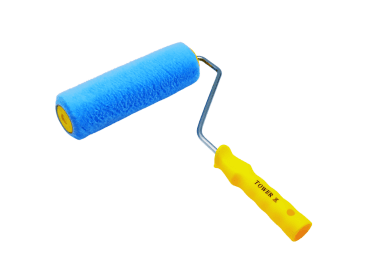
The Tower Paint Roller Lineup
Four rollers, each matched to a specific paint chemistry and surface type. All four share the same construction standard.
| Roller | Fabric | Pile | Construction | Best For |
|---|---|---|---|---|
| Super Roller (Blue) | Lint-free | 12.5mm | Thermal-bonded | Water-based paint, smooth surfaces — walls, ceilings, general work |
| Super Roller (Cream) | Lint-free | 25mm | Thermal-bonded | Water-based paint, rough surfaces — walls, ceilings, general work |
| Mohair | Mohair | 6mm | Thermal-bonded | Oil-based paint |
| Nylon | Nylon | 5mm | Thermal-bonded | Epoxy paint |
All four rollers share the same construction backbone: thermal-bonded fabric (not glued) for full-shift durability in UAE summer conditions. The differences are in fabric type and pile length, matched to specific paint chemistries and surface textures.
Why Thermal-Bonded Construction Matters
The fabric on a paint roller has to be attached to the core somehow. Cheaper rollers use adhesive (glue) — which works on water-based emulsion but breaks down when exposed to the solvents in epoxy, oil-based gloss and polyurethane paints. The roller then sheds fabric into the finish, loses shape mid-stroke, or comes apart entirely.
Thermal-bonded construction fuses the fabric to the core with heat instead of glue. There's no adhesive to break down, so the same roller stays intact across paint chemistries — and lasts longer in UAE summer heat where adhesive failure is accelerated.
Every Tower Tools roller — Super Roller, Mohair and Nylon — uses thermal-bonded construction. It's the construction standard across the line, not just on the chemical-resistant variants.
Pile Length — What to Use for What
Pile length determines how much paint the roller carries and how it interacts with surface texture. Shorter pile (5–6mm) is matched to smooth surfaces and finishes that should not show roller texture; longer pile (20mm+) carries more paint and reaches into the recesses of textured or rough substrates.
| Pile | Tower Roller | What It's For |
|---|---|---|
| 5mm | Nylon | Epoxy paint on smooth surfaces (industrial floors, machinery, tank coatings) |
| 6mm | Mohair | Oil-based gloss and varnish on smooth surfaces |
| 12.5mm | Super Roller (Blue) | Water-based emulsion on smooth-to-medium walls and ceilings |
| 25mm | Super Roller (Cream) | Water-based emulsion on rough or textured walls, ceilings and exterior surfaces |
Match pile length to surface first, then check that the fabric is right for your paint chemistry. A 25mm Super Roller (Cream) on a smooth wall will leave too much texture; a 5mm Nylon roller on rough exterior masonry won't reach into the surface.
5 Mistakes UAE Buyers Make — And How to Avoid Them
Patterns we see repeatedly across UAE jobsites and through our distribution partners.
1. Using a glued roller for epoxy or oil-based paint.
The adhesive holding the fabric to the roller core breaks down when exposed to the solvents in epoxy, oil-based gloss, or polyurethane paint. The fabric then sheds into the finish or comes off the core mid-stroke. Use thermal-bonded construction for any solvent-based or 2-component paint. All Tower rollers are thermal-bonded.
2. Using long pile (25mm) on smooth walls.
Long-pile rollers carry more paint, but lay it down with visible texture. For smooth wall finishes where you don't want roller texture, use a 12.5mm Super Roller (Blue) or shorter. Save the 25mm Super Roller (Cream) for textured walls, masonry, and exterior surfaces.
3. Using short pile (5–6mm) on rough or textured surfaces.
Short-pile rollers don't reach into recesses in textured plaster, masonry, or exterior render. Result: patchy coverage and a second or third pass. On any surface where you can feel texture by hand, step up to a 25mm Super Roller (Cream).
4. Using one roller fabric across all paint types.
Tower's lineup is matched per paint chemistry: lint-free Super Roller for water-based emulsion, Mohair for oil-based, Nylon for epoxy. Using one roller across all paints either limits which paints you can apply with it, or shortens the roller's lifespan when used outside its designed chemistry. Match the roller to the paint, not just the surface.
5. Skipping end-of-day cleaning in UAE summer.
Paint left in a roller in a 45°C+ site cabin overnight hardens the fabric — even wrapped. By morning the roller is unusable. Clean fully at end of shift, spin out excess water, wrap in cloth or plastic. A correctly cleaned thermal-bonded roller lasts the project; a poorly cared one is binned in days.
Caring for Paint Rollers in UAE Conditions
Heat, humidity and dust mean UAE professionals need a slightly different roller care routine than the manufacturer label assumes.
End-of-day cleaning
- ✓Water-based paint: rinse the roller under running water, working the fabric gently until water runs clear; spin out excess water by hand.
- ✓Oil-based / solvent paint: clean with white spirit or mineral turpentine first, then warm soapy water; spin out excess.
- ✓Epoxy / 2-component paint: clean with the manufacturer-specified solvent before the paint cures — once cured, the roller is unrecoverable.
Drying & storage
- ✓Stand the roller on its end to dry, or hang it on a hook — never lay it flat with weight on the fabric.
- ✓Store out of direct sunlight (UV degrades fabrics over time).
- ✓Wrap a clean, almost-dry roller in cloth or plastic to protect it from dust between jobs.
- ✓Avoid hot site cabin overnight storage in summer — heat accelerates wear, and any residual paint hardens.
When to retire a roller
- ✗Fabric flares permanently and won't reshape after washing.
- ✗Visible shedding into the painted finish.
- ✗Core or frame loosens or develops play.
- ✗Cured paint locks the fabric solid (most common with skipped epoxy clean-up).
Site hygiene
- ✓Rinse the roller fully when switching paint colors to avoid contamination.
- ✓Use a separate roller for primer vs topcoat where the chemistry differs.
- ✓Keep rollers wrapped or covered between jobs to keep dust and grit out of the fabric.
Paint Roller vs Paint Brush — When to Use Each
Both tools have their place on a UAE jobsite. The roller is for speed and uniform coverage on open surfaces; the brush is for control and detail.
Use a Paint Roller when:
- ✓Covering large flat surfaces — walls, ceilings, floors, exterior cladding.
- ✓Maximum coverage speed on open areas matters.
- ✓Applying emulsion, latex, or epoxy across broad surfaces.
- ✓A consistent, uniform texture is needed across the whole surface.
For roller selection, see Tower's paint roller range.
Use a Paint Brush when:
- ✓Cutting in along edges, ceiling lines, door frames, baseboards.
- ✓Painting narrow trim, joinery, or window mullions.
- ✓Working in spaces inaccessible to a roller (corners, behind fixtures, irregular shapes).
- ✓Applying oil-based gloss or varnish on small areas where finish smoothness matters.
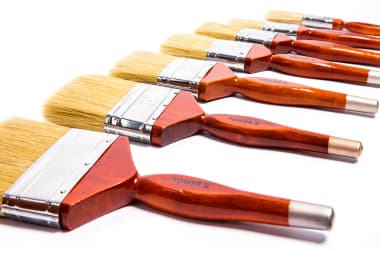
See the Tower Tools paint brush range or the paint brushes buyer's guide for a deeper walk-through.
Most UAE professional crews use both on the same job — a brush for cutting in around edges and frames, then a roller for the open surface.
Frequently Asked Questions
Common questions UAE buyers ask about paint rollers — answered with our verified product facts.
What is the best paint roller for emulsion (water-based) paint in UAE?
+
The Tower Super Roller — lint-free fabric, thermal-bonded to the core. The Blue (12.5mm pile) is for smooth walls and ceilings; the Cream (25mm pile) is for textured walls, masonry, and exterior surfaces. Both are designed specifically for water-based emulsion.
What's the difference between Mohair and Nylon rollers?
+
Mohair is for oil-based gloss and varnish on smooth surfaces — 6mm pile, fine finish. Nylon is for epoxy paint on smooth surfaces — 5mm pile, solvent-resistant. They're both thermal-bonded so the fabric doesn't separate from the core when exposed to solvents.
Can I use one paint roller for all paint types?
+
No — fabric and pile are matched to paint chemistry. Lint-free Super Roller is for water-based. Mohair is for oil-based. Nylon is for epoxy. Using the wrong fabric either limits what you can apply, or shortens the roller's lifespan when used outside its designed chemistry.
What is a thermal-bonded paint roller and why does it matter?
+
Thermal-bonded means the fabric is fused to the core with heat instead of glue. Glue-based adhesives break down when exposed to solvents in epoxy, oil-based gloss, or polyurethane paints — the roller then sheds fabric into the finish or comes apart mid-stroke. Every Tower roller (Super Roller, Mohair, and Nylon) is thermal-bonded.
What pile length should I use for smooth walls?
+
12.5mm (Tower Super Roller Blue) for smooth-to-medium walls and ceilings with water-based emulsion. Going longer than that on a smooth wall leaves visible roller texture; going shorter loses too much paint pickup.
What pile length should I use for textured or rough walls?
+
25mm (Tower Super Roller Cream). The longer pile reaches into the recesses of textured plaster, masonry, or exterior render. A short-pile roller on a rough surface gives patchy coverage and forces a second or third pass.
How long do paint rollers last in UAE conditions?
+
A correctly cleaned thermal-bonded Tower roller lasts the full project across multiple shifts. Heat and dust shorten the life of glued rollers significantly faster — adhesive failure is accelerated in 45°C+ site cabins. End-of-day cleaning and out-of-sun storage make the biggest difference.
Can I clean and reuse a paint roller after epoxy paint?
+
Only if you clean it before the epoxy cures, using the manufacturer-specified solvent. Once epoxy cures inside the fabric, the roller is unrecoverable. Tower Nylon rollers handle epoxy chemistry safely; the limit is how fast you clean it after the shift, not the roller.
Does Tower Tools sell paint rollers directly to the public?
+
No — Tower Tools is a brand-first organization. Rollers are supplied through trading companies and authorized distributors across UAE, Oman, Lebanon and the GCC. For a quote, contact us via WhatsApp at +971 50 971 6700.
Where can I buy Tower paint rollers in Dubai?
+
Through authorized trading-company distribution. Tower Tools warehouses out of DIP 1 FAB warehouse, building 5, warehouse 3 - Dubai, and supplies trading partners across Dubai, Abu Dhabi, Sharjah, Ras Al Khaimah and Umm Al Quwain. WhatsApp +971 50 971 6700 for distributor referral.
Where to Buy
Professional Rollers in UAE
Tower Tools (operated by Assist International Building Material Trading LLC) supplies professional-grade paint rollers — Super Roller (Blue & Cream), Mohair, and Nylon — to trading companies and authorized distributors across the UAE.
Distribution covers Dubai, Abu Dhabi, Sharjah, Ras Al Khaimah and Umm Al Quwain. Tower rollers are also used on contracted projects across Oman, Lebanon and the wider GCC.
Quick Inquiry
Tower Tools — supplying professional painting tools across the Middle East since 1977.
Last updated: May 2026. Reviewed by the Tower Tools technical team. Sources: 47 years of supplying paint rollers to UAE construction and contracting sites since 1977; manufacturer specifications for Super Roller (Blue & Cream), Mohair and Nylon series; feedback from authorized UAE distribution partners; published guidance on solvent-resistant roller construction from Pro Roller.

.jpg&w=1200&q=75)